Lactococcosis in Fish and CrossProtection Evidence of ICTHIOVAC® LG
Posts
Fish
Lactococcosis is a major bacterial disease affecting farmed fish species worldwide, generating significant economic losses and posing an increasing challenge for aquaculture. Traditionally, Lactococcus garvieae was considered the primary etiological agent responsible for lactococcosis outbreaks in both freshwater and marine species 1 . However, advances in molecular taxonomy have reshaped our understanding of this pathogen group. Recent reclassifications based on genomic analyses have revealed that Lactococcus petauri—described as a new species in 2017²—has been responsible for many outbreaks previously attributed to L. garvieae, particularly in rainbow trout 3.
ICTHIOVAC® LG, originally developed using a strain characterized at the time as L. garvieae 4, has been used extensively in trout farming. Subsequent molecular analyses, including gyrB PCR and whole genome sequencing, demonstrated that this strain actually belongs‑ to L. petauri. Importantly, this updated classification does not modify its biological identity or its immunogenic capacity, a conclusion later endorsed by the European Medicines Agency (EMA), which officially updated the SPC in 2025.
Global surveillance indicates that L. petauri and L. garvieae coexist in diverse aquatic environments and animal reservoirs 5 and clinically, infections caused by both species are nearly identical, showing exophthalmia, hemorrhages, darkening and systemic signs—an overlap that historically contributed to widespread misclassification. Indeed, re‑evaluation of archived isolates revealed that over 60% of samples previously labelled as L. garvieae in trout were actually L. petauri 3.
It is important to note that as the literature on Lactococcus expands, notable differences have emerged between freshwater focused studies from Europe and the Americas and the marine oriented research led mainly by Japanese authors, reflecting the absence of a unified classification framework. This divergence in taxonomic traditions can generate confusion when interpreting historical literature or comparing epidemiological patterns across regions: While Western research increasingly relies on species level identification based on genomic criteria —particularly to distinguish L. garvieae, L. petauri, and L. formosensis 6,7— Japanese studies have historically used a serotype based system for characterizing Lactococcus isolates from marine fish 8,9,10.
However, modern genomic analyses help harmonize both views:
In Japanese marine aquaculture, especially in striped jack Pseudocaranx dentex and greater amberjack Seriola dumerili, the literature describes three serotypes within what was traditionally referred to as L. garvieae: serotype I, serotype II (later reclassified as L. formosensis through genetic analyses), and serotype III, a recently recognized variant that does not agglutinate with antisera for types I or II and exhibits distinct genetic identity, corresponding to the ST95 lineage. 8,9,10. This serotype III group has been highlighted as an emerging pathogenic lineage in Japan and shows clear genomic separation from L. garvieae serotype I and L. formosensis.
On the other hand, in Mediterranean studies, L. garvieae has also been detected as an emerging pathogen both in seabass and seabream 11,12 , clustering the isolates with Japanese and Chinese marine strains belonging to the ST95 lineage (named MS210922A and ZB1/1-2708) 8,9,10, , defining this “serotype III” group affecting seabass and seabream 11,12.
However, in the study of Fouz et al. (2026) 13 , Spanish marine strains were typed as serotype I using the widely employed PCR assay of Ohbayashi et al. (2017) 14. Recent publications10 confirm that current molecular serotyping tools fail to differentiate serotype III from serotype I since the serotype III lineage was described after the development of these primers 10,14 and is not specifically targeted by them.
In freshwater systems of Europe and the Americas, recent genomic surveys reveal that a large proportion of isolates historically reported as L. garvieae were in fact L. petauri 2,6, and while L. petauri and L. garvieae dominate infections in species such as trout and tilapia, even salmon, L. formosensis is comparatively rare. 7
These taxonomic clarifications have significant implications for diagnosis, surveillance, and vaccine development. But beyond nomenclature, the real operational question for producers and veterinarians is whether a vaccine based on a single strain can protect fish against the wider diversity of Lactococcus species, serotypes, and emerging lineages.
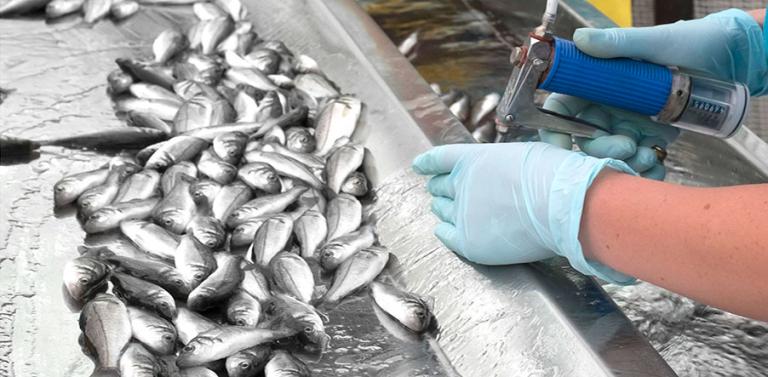
A key question following the taxonomic revision was whether ICTHIOVAC® LG—containing a L. petauri strain—would protect against both L. petauri and L. garvieae. A multiregional experimental challenge using isolates from Spain (L. petauri), Italy (L. garvieae), Greece (L. petauri), and South Africa (L. petauri) showed that vaccinated trout achieved Relative Percent Survival (RPS) values above 82% across all strains tested 15
Vaccination significantly reduced mortality and the severity of clinical signs. Protection was effective regardless of:
- The species (L. petauri or L. garvieae),
- The geographic location of the isolates.
Between 2023 and 2024, genomic data confirmed that the ICTHIOVAC® LG vaccine strain is unequivocally L. petauri. Based on this evidence, the EMA approved in 2025 the update of the vaccine’s Summary of Product Characteristics, officially recognizing:
- The new taxonomic classification of the strain,
- The absence of changes in safety or efficacy,
- Proven cross‑protection between L. petauri and L. garvieae.
The taxonomy of Lactococcus in fish continues to evolve thanks to modern molecular tools, strengthening the scientific basis for disease prevention strategies. ICTHIOVAC® LG is currently the only commercially available vaccine supported by relevant studies that includes Lactococcus petauri in its formulation for the control of lactococcosis in aquaculture. Its demonstrated cross‑protection and the EMA‑validated new taxonomic classification of the strain support the product’s alignment with current epidemiology and scientific accuracy.
References
1 Vendrell D, Balcázar JL, Ruiz-Zarzuela I, de Blas I, Gironés O, Múzquiz JL. Lactococcus garvieae in fish: a review. Comp Immunol Microbiol Infect Dis. 2006 Jul;29(4):177-98. doi: 10.1016/j.cimid.2006.06.003. Epub 2006 Aug 28. PMID: 16935332.
2 Goodman LB, Lawton MR, Franklin-Guild RJ, Anderson RR, Schaan L, Thachil AJ, Wiedmann M, Miller CB, Alcaine SD, Kovac J. Lactococcus petauri sp. nov., isolated from an abscess of a sugar glider. Int J Syst Evol Microbiol. 2017 Nov;67(11):4397-4404. doi: 10.1099/ijsem.0.002303. Epub 2017 Sep 25. PMID: 28945531; PMCID: PMC5845659.
3 Vela AI, Blanco MM, Colussi S, Kotzamanidis C, Prearo M, Altinok I, Acutis PL, Volpatti D, Alba P, Feltrin F, Ianzano A, Domínguez L, Fernández-Garayzábal JF. 2024. The association of Lactococcus petauri with lactococcosis is older than expected. Aquaculture 578:740057.
4 Vendrell D, Balcázar JL, Ruiz-Zarzuela I, de Blas I, Gironés O, Múzquiz JL. Safety and efficacy of an inactivated vaccine against Lactococcus garvieae in rainbow trout (Oncorhynchus mykiss). Prev Vet Med. 2007 Jul 16;80(2-3):222-9. doi: 10.1016/j.prevetmed.2007.02.008. Epub 2007 Mar 26. PMID: 17386951.
5 MicrobeAtlas.org, “Taxon view.” https://microbeatlas.org/taxon?taxon_id=90_58;96_192;97_208;98_233;99_274
6 Heckman TI, Yazdi Z, Older CE, Griffin MJ, Waldbieser GC, Chow AM, Medina Silva I, Anenson KM, García JC, LaFrentz BR, Slavic D, Toohey-Kurth KL, Yant P, Fritz HM, Henderson EE, McDowall R, Cai H, Adkison M, Soto E.2024.Redefining piscine lactococcosis. Appl Environ Microbiol90:e02349
7 Shahin K, Mansour W, Khurshid S, Abdel‑Glil M, Saticioglu IB, Duman M, Altun S, Colussi S, Esposito G, Acutis PL, Prearo M, Altinok I, Kotzamanidis C, Vela AI, Soto E, Leal CAG, Matthews C. 2025. Diving into the depths: Unveiling the main etiologies of piscine lactococcosis with a novel multiplex qPCR assay. J Fish Dis 48(11):e14147
8 Akmal M, Yoshida T, Nishiki I. Complete Genome Sequence of Lactococcus garvieae MS210922A, Isolated from Farmed Greater Amberjack (Seriola dumerili) in Japan. Microbiol Resour Announc. 2022 Dec 15;11(12):e0089022. doi: 10.1128/mra.00890-22. Epub 2022 Nov 22. PMID: 36413034; PMCID: PMC9753671.
9 Araki K, Nishiki I, Yoshida T. 2024. Characterization and epidemiological study of newly emerging Lactococcus garvieae serotype III in farmed fish in Japan. Fish Pathology 59:119–126
10 Araki K, Mouri A, Minami T, Nishiki I, Yoshida T. 2024. Development of a discriminating method for pathogenic bacteria that cause lactococcal infections in marine fish farms in Japan. Fish Pathology 59:63–70.
11 Salogni C, Bertasio C, Accini A, Gibelli LR, Pigoli C, Susini F, Podavini E, Scali F, Varisco G, Alborali GL. The Characterisation of Lactococcus garvieae Isolated in an Outbreak of Septicaemic Disease in Farmed Sea Bass (Dicentrarchus labrax, Linnaues 1758) in Italy. Pathogens. 2024; 13(1):49.
12 González-Martín D, Ubieto M, del Caso S, Planas E, Ruiz-Zarzuela I, Sanz C, Arnal JL. 2026. Comparative molecular and antimicrobial analysis of Lactococcus garvieae and Lactococcus petauri from marine and freshwater fish farms in the Mediterranean. Animals 16(2):277.
13 Fouz B, Carballeda-Carrasco E, Barriga-Cuartero J, Torres-Corral Y, Robles Á, Zarza C, Santos Y. First Description and Characterisation of Lactococcus garvieae Strains Causing Septicaemic Disease in Farmed Sea Bass (Dicentrarchus labrax; Linnaeus) in Spain. J Fish Dis. 2026 May;49(5):e70089.
14 Ohbayashi, K., D. Oinaka, T. D. Hoai, T. Yoshida, and I. Nishiki. 2017. “PCRMediated Identification of the Newly Emerging Pathogen Lactococcus garvieae Serotype II From Seriola quinqueradiata and S. dumerili.” Fish Pathology 52, no. 1: 46–49
15 Barril Basil, I. Verdaguer Sentmartí, J.Espinosa Masmitjà, T, Callol Junyer, Merino Pérez, R. Efficacy of ICTHIOVAC® LG against geographically different strains of Lactococcus garvieae in rainbow trout (Oncorhynchus mykiss). Poster presented at: AquaFarm; 2023.
16 Baratelli, M. Verdaguer Sentmartí, J. Sánchez-Leiva. R, Callol Junquer. A, Merino Pérez. R, Espinosa Masmitjá T. Cross-species protection: A commercial trout vaccine protects Dicentrarchus labrax (European seabass) against Lactococcus garvieae strains isolated from seawater outbreaks.
Poster presented at: EAFP Conference; 2025.